Asbestos guide · Updated October 17, 2026
Asbestos in Homes: A Clear Guide for Québec Homeowners
Asbestos is a mineral fibre found in many materials in homes built before 1990, and when it is intact and non-friable it poses no significant health risk, according to Québec.ca and Health Canada. The danger starts when you drill, sand or demolish it, so before you renovate, have the material tested and leave removal to a qualified contractor.
On this page
Finding asbestos in homes is common in Québec, and it is often less alarming than it sounds. An asbestos material that is intact, in good condition and left alone poses no significant health risk. The real issue is renovation. This guide explains what asbestos is, where it hides in a Québec house, when it becomes a risk, and how to have it tested or removed safely. Every fact comes from an official source listed at the bottom of the page.
What is asbestos?
Asbestos is a natural mineral made of very fine fibres. It resists heat, fire and wear, and it was cheap. For decades, manufacturers added it to hundreds of building products: insulation, plaster, flooring, ceilings and siding.
Once released into the air, the fibres are too small to see. That is what makes asbestos tricky: a material can contain it with no visible sign. Only a lab analysis can confirm it.
Two words come up often in this guide:
- Friable: a material that crumbles or turns to powder under hand pressure. It releases fibres easily.
- Non-friable: a hard, bonded material, such as a vinyl floor tile or an asbestos-cement panel. It only releases fibres if it is broken, cut or sanded.
Why asbestos is a health concern
The danger comes from the fibres. When an asbestos material is drilled, sanded, broken or starts to deteriorate, microscopic fibres get into the air, and people breathe them in without noticing.
Québec.ca links asbestos exposure to several diseases:
- asbestosis, a chronic lung disease;
- mesothelioma, a rare form of cancer;
- lung cancer;
- cancer of the larynx and of the ovary.
These diseases can take several decades to appear. That is why the absence of symptoms tells you nothing about a past exposure. If you are worried about an exposure, talk to your doctor or call Info-Santé 811.
Québec also sets a strict limit for workers. In 2022, it lowered the permissible exposure value (VEA, for valeur d'exposition admissible) for asbestos to 0.1 fibre per cubic centimetre of air. The VEA is the highest fibre concentration a worker may be exposed to. Our health page has more detail: asbestos and health (in French).
Which homes are affected?
The simple rule: a house built before 1990 may contain asbestos. The older the house, the more it is worth checking before you start work.
A few official dates help you place your home:
| Benchmark | Date | Source |
|---|---|---|
| Vermiculite insulation that may contain asbestos | sold between 1920 and 1990 | Québec.ca |
| Sprayed-on asbestos (flocking), employer inventory | buildings built before February 15, 1990 | CNESST |
| Pipe and boiler insulation, employer inventory | buildings built before May 20, 1999 | CNESST |
The last two dates come from a rule for employers. It does not apply directly to an owner-occupied house, but the same dates are a useful benchmark.
This is not a rare situation on the Rive-Sud. According to Statistics Canada's 2021 Census, 55.3% of homes in Longueuil and 55.0% in Châteauguay were built before 1981, and 56.1% of homes in Brossard were built before 1991. See our local pages for asbestos removal in Longueuil, Brossard and Châteauguay.
Where asbestos hides in a house
Asbestos can turn up anywhere from the basement to the attic. These are the usual suspects.
Walls and ceilings
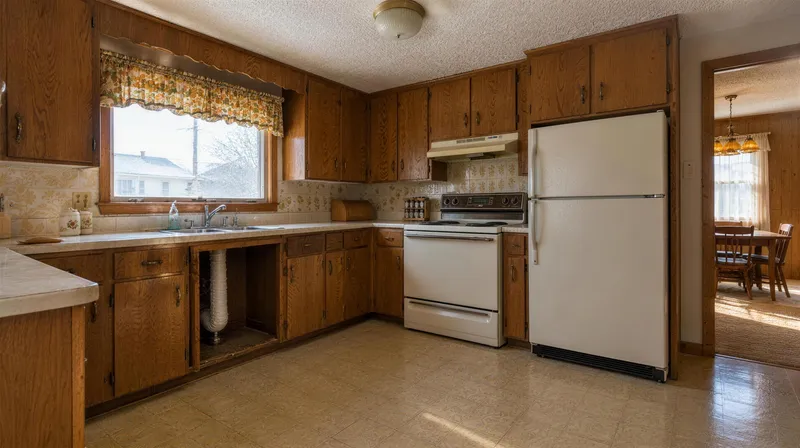
Drywall joint compound, some plasters and textured wall and ceiling finishes may contain asbestos. The "popcorn" textured ceiling is a common example.
Floors
Vinyl floor tiles, sheet vinyl and the black adhesive under them are classic suspects in kitchens, bathrooms and basements.
Insulation
Three types of insulation deserve attention: vermiculite in the attic, pipe insulation wrapped around heating pipes and boilers, and sprayed-on insulation on a structure.
Vermiculite needs special care. Health Canada says much of it came from the Libby mine in Montana and was sold mostly under the Zonolite brand. Our guide to vermiculite insulation shows how to recognize it, and our page on attic insulation removal covers removal and re-insulation.
Outside the house
Some asbestos-cement siding and shingles, often grey and rigid, contain asbestos. They are non-friable as long as they stay intact.
Old basements and attics can also have moisture problems. If you see stains or smell must, our guide to mould removal explains what to do.
Is asbestos dangerous if nobody touches it?
In most cases, no. Québec.ca says asbestos materials in good condition do not release fibres into the air and are generally safe. Health Canada agrees: there are no significant health risks when they are left undisturbed, isolated in an attic, sealed behind walls and floorboards, or tightly bound in products in good condition.
The situation changes in three cases:
- You renovate. Drilling, sanding, cutting or demolishing a material releases fibres. This is the main source of exposure in a home.
- The material deteriorates. Crumbling pipe insulation, a textured ceiling damaged by a leak, or vermiculite falling through a crack in the ceiling can release fibres.
- You disturb a friable material. Storing boxes in an attic full of vermiculite stirs the insulation. Health Canada advises keeping the attic clear of stored items in that case.
If you are unsure about a material, Québec.ca says to handle it as if it contains asbestos until it is tested.
Before you renovate: a quick checklist
Planning work in a house built before 1990? Take ten minutes to go through this list.
- Which materials will the work touch: walls, ceilings, floors, insulation, pipes?
- Is any of them a classic suspect (textured ceiling, vinyl tiles, joint compound, vermiculite, pipe insulation)?
- Do you have a test result for each one, layer by layer?
- If a result is positive, is removal planned before the other work, by a trained contractor?
- Does your general contractor know which areas to avoid in the meantime?
If you answer "I don't know" to any of these, start with a test. It is the cheapest way to avoid contaminating the whole house.
Asbestos testing
Testing is the only way to know. A small sample of the material is taken, sealed and analyzed in a lab. The report says whether asbestos is present, and often in what proportion.
Typical prices, indicative, October 2026:
| Service | Price range |
|---|---|
| Lab analysis, per layer of material (homeowner rate, before tax) | $165 (1 week) to $395 (1 hour) |
| Inspection with sampling and report | $500 to $950 (about $650 for 3 samples) |
| Usual lab turnaround | 2 to 5 business days |
Sources: EMSL Canada homeowner price list for lab analysis; RenoQuotes (April 2026) for inspections and turnaround.
Air tests also exist. They measure fibres floating in the air, for example at the end of a removal job. Our asbestos testing page covers how the lab works, the air test and what testing costs.
Removal and the rules
If a test is positive and your project will disturb the material, plan for asbestos removal first. It is a controlled job, not ordinary demolition.
What the rules say
In Québec, asbestos work on a construction site falls under the Code de sécurité pour les travaux de construction (Construction Safety Code, CSTC), subsection 3.23. CNESST, Québec's workplace health and safety board, enforces it. The code sorts asbestos work into three risk levels: low, moderate and high.
- Low risk: handling or removing non-friable products that stay intact, such as vinyl tiles, gaskets and asbestos-cement.
- Moderate risk: for example, removing drywall installed with asbestos joint compound, or removing a false ceiling to reach friable material.
- High risk: removing friable asbestos, or using power tools without HEPA dust extraction on asbestos products.
High-risk jobs need a sealed enclosure under negative pressure. That means fans pull air out of the work area through filters, so fibres cannot escape into the rest of the house. HEPA stands for high-efficiency particulate air: a filter that traps very fine particles, including asbestos fibres.
Doing it yourself
Removing asbestos yourself is strongly discouraged. Québec.ca tells homeowners never to do the work themselves. During the work, stay out of the area and shut down your home's ventilation system.
The contractor seals the waste in labelled containers and takes it to an authorized landfill. Never take asbestos to an écocentre (municipal drop-off centre): Châteauguay's écocentre, for one, explicitly refuses it.
Choosing a contractor
Québec has no official asbestos accreditation or certification program. Québec.ca recommends checking two things instead:
- a licence from the Régie du bâtiment du Québec (RBQ), Québec's building authority, in subclass 1.2, 1.3, 2.7 or 7;
- the workers' asbestos training and experience.
We are an information and referral service. The work is done by a partner contractor in your area that holds its own RBQ licence. To get an estimate, fill out a quote request.
What it costs
As an indication in October 2026, a full asbestos removal job in a typical house runs about $4,000 to $11,000, according to RenoQuotes (June 2026). The price depends heavily on the material, the area and the risk level. No grant covers asbestos removal, to our knowledge; the re-insulation that follows may qualify for Rénoclimat. The details are on our asbestos removal cost page.
Frequently asked questions
How can I tell if my house has asbestos?
You can't tell by looking. Only a lab analysis of a sample of the material can confirm it. Until you have a result, Québec.ca says to handle any doubtful material as if it contains asbestos.
Is it dangerous to live in a house with asbestos?
Not if the materials are in good condition, non-friable and left alone. Health Canada says there are no significant health risks when they are undisturbed or sealed behind walls and floorboards. The risk comes from work that releases fibres into the air, such as drilling, sanding or demolition.
Can I remove asbestos myself?
It is strongly discouraged. Québec.ca tells homeowners never to do the work themselves and to hire a contractor with the right RBQ licence and asbestos training instead.
Which houses are most likely to contain asbestos?
Homes built before 1990 are the main concern. Québec.ca notes that some vermiculite insulation sold between 1920 and 1990 may contain asbestos. The older the house, the more it is worth testing before renovation work.
How much does an asbestos test cost?
As an indication in October 2026, lab analysis costs $165 to $395 per layer of material depending on turnaround (EMSL Canada price list). An inspection with sampling and a report runs about $500 to $950, according to RenoQuotes.
Is there a grant for asbestos removal?
No grant covers asbestos removal, to our knowledge. The attic re-insulation that follows may qualify for Rénoclimat, which pays $50 to $1,500 depending on the work.
Sources
- Québec.ca — Preventing health problems associated with asbestos
- Québec.ca — Effects of asbestos on health
- Québec.ca — Effets de l'amiante sur la santé (latency wording) (in French)
- Health Canada — Health risks of asbestos
- Health Canada — Advisory: vermiculite insulation may contain asbestos (archived, 2004)
- CNESST — Asbestos: safe management and employer inventory
- INSPQ — Asbestos exposure on construction sites (in French)
- ASP Construction — Prevention during work that may release asbestos dust, 2023, rev. 2024 (in French)
- Québec.ca — New permissible exposure values for airborne asbestos, 2022 (in French)
- Statistics Canada — 2021 Census, dwellings by period of construction (table 98-10-0233-01)
- EMSL Canada — Sample submittal form and price list (homeowners)
- RenoQuotes — Asbestos testing cost: what to expect before renovating (April 2026)
- RenoQuotes — Asbestos abatement costs in Québec in 2026 (June 2026)
- Ville de Châteauguay — Écocentre (in French)
- Québec.ca — Rénoclimat insulation grant (in French)
Updated
Free quote
Talk to a qualified contractor in your area.
Describe your situation in two minutes. Your request goes to a partner contractor in your area only and is never resold.