Service · Updated October 17, 2026
Asbestos Testing: How It Works and What It Costs
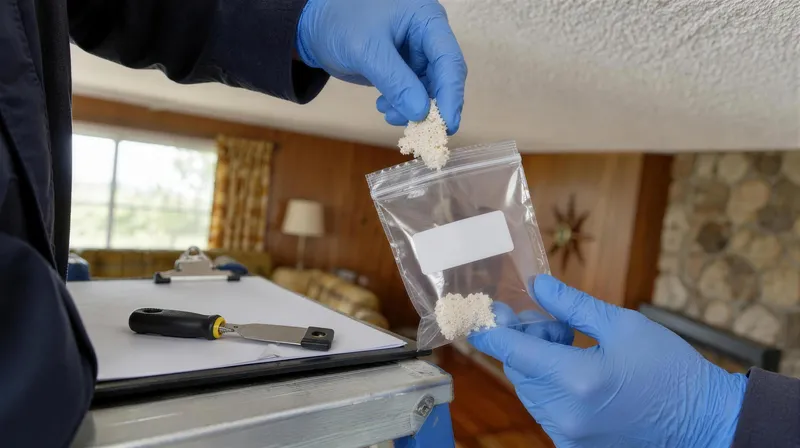
Asbestos testing means taking a small sample of a suspect material and sending it to a lab, which confirms whether asbestos is present, layer by layer. Expect $165 to $395 per layer depending on turnaround, or $500 to $950 for an inspection with sampling and a report (indicative, October 2026).
On this page
You can't see asbestos. A textured ceiling, joint compound or vinyl tile may or may not contain it, and only asbestos testing in a lab can settle the question. The good news: Québec.ca says asbestos materials in good condition do not release fibres into the air and are generally safe. Testing becomes useful, and often necessary, as soon as you plan to drill, sand, demolish or renovate. This page covers when to test, who should take the sample, how the lab works, what an air test is for, what it costs and how to read the report.
When to get an asbestos test
Health Canada says there are no significant health risks when asbestos is left undisturbed or sealed behind walls and floorboards. The danger comes from fibres released when the material is damaged. So have a suspect material tested in these situations:
- Before renovating a house built before 1990: opening a wall, removing a floor, redoing a ceiling, replacing a furnace.
- When a material is damaged or friable. Friable means it crumbles or turns to powder under hand pressure.
- When you find grey-brown, pebbly insulation in the attic. It may be vermiculite insulation, which may contain asbestos.
- Before buying an older house, so you know the cost of any work before your conditions expire.
Until you have a result, Québec.ca says to handle any doubtful material as if it contains asbestos. For contractors, this is not just advice but a requirement: the Construction Safety Code (CSTC, s. 3.23.3) requires identifying asbestos before work starts.
The materials most often tested in a home are drywall joint compound and plaster, textured wall and ceiling finishes, vinyl tiles and sheet vinyl, pipe insulation and vermiculite. Our guide to asbestos in homes covers each one.
Sampling: professional or do it yourself?
Taking a sample means cutting or scraping off a piece of the material. Even that small step can release fibres. Québec.ca strongly discourages homeowners from doing work themselves on a material that may contain asbestos, so safety comes before savings.
By a professional
A trained inspector or contractor identifies the suspect materials, picks the right spots to sample and decides how many samples are needed. They wear proper protective equipment, seal and label each sample, then send it to the lab. You get a report that locates each sample. This is the way to go before major work or when several materials are involved.
With a kit
Home test kits exist. They include the container and the lab analysis. If you go this route:
- follow the lab's instructions to the letter;
- never sample a friable or damaged material;
- keep children and pets away during sampling;
- fill out the lab's sample submission form.
Lab analysis: how it works
The lab examines the sample under a microscope and reports whether asbestos fibres are present. Two methods often appear on reports:
- PLM (polarized light microscopy): an optical microscope that identifies asbestos fibres by how they behave under polarized light. It is the standard analysis for building materials.
- TEM (transmission electron microscopy): a far more powerful electron microscope that can see very fine fibres. EMSL Canada uses TEM for vermiculite.
Why the price is "per layer"
A sample often has several layers: plaster and its textured paint, a tile and its adhesive, a drywall panel and its joint compound. Each layer may or may not contain asbestos. The lab analyzes each layer separately, so the bill follows the number of layers.
Choosing the lab
- Ask which accreditation the lab holds for asbestos analysis, and check that it appears on the report.
- Ask for the turnaround and the price per layer before you send the sample.
- Keep a copy of the sample submission form. It follows the sample from collection to result.
Standard turnaround is 2 to 5 business days. Rush service costs 50% to 100% more.
Air testing: what it is for
An air test does not replace a material analysis. A pump draws a known volume of air through a filter, and the fibres collected are counted. The result is expressed in fibres per cubic centimetre of air (f/cm³). It tells you what is floating in the air at that moment, not what your ceiling contains.
Air testing is mainly used during and after removal work:
- During the job. On a high-risk site, the Construction Safety Code (s. 3.23.16) requires air sampling every shift, with results within 24 hours.
- After removal. Sampling before the containment comes down checks that the cleanup is complete. Ask the contractor whether it is included in the quote and who does it.
In 2022, Québec lowered its permissible exposure value (VEA) for asbestos to 0.1 fibre per cubic centimetre of air. This limit protects workers on a work site. It is not a threshold designed for an occupied home.
The price of an air test depends on the number of samples and when it is done. It is set on quote.
What asbestos testing costs
| Service | Indicative price | Turnaround |
|---|---|---|
| Lab analysis of a material, per layer (homeowner rate, before tax) | $165 to $395 | $165 for 1 week, $395 for 1 hour |
| Vermiculite analysis (TEM), per sample | $395 to $595 | depends on turnaround chosen |
| Home test kit, lab analysis included | $195 to $350 | 2 to 5 business days |
| Inspection with sampling and report | $500 to $950 (about $650 for 3 samples) | 2 to 5 business days |
| Rush service | +50% to 100% | depends on the lab |
| Air test | on quote | depends on the job |
Indicative, October 2026. Sources: EMSL Canada homeowner price list for lab analysis; Soumission Rénovation and its English site RenoQuotes (April 2026) for kits, inspections and turnaround.
A simple example: a ceiling sample with two layers (plaster and textured finish) analyzed at the one-week rate costs 2 × $165, or $330 before tax.
That is small next to the cost of removal or renovation. A negative result can spare you specialized work. A positive result lets you get an accurate quote and plan your budget. See our page on asbestos removal cost for the next step, or request a quote from a partner contractor in your area.
Reading a lab report
A lab report looks technical, but you can read it in a few minutes. It usually shows:
- Sample ID: the number and where it was taken.
- Description of each layer: colour, texture, type of material.
- Analysis method: PLM or TEM.
- Result: asbestos detected or not detected. If detected, the report often gives the fibre type and percentage.
A few pointers:
- "Not detected" applies to the sample analyzed. If the same material was installed at different times, the inspector may recommend several samples.
- A single positive layer is enough for the material to be treated as asbestos during the work.
- A positive result is not an emergency if the material is intact and you are not planning work.
Keep the report with your house documents. It will help the contractor who prepares the quote and, later, when you sell and fill out the seller's declaration.
South Shore / Montérégie
Asbestos testing and lab analysis in your city
Each local page covers the housing stock, where asbestos debris goes and the permits to plan for.
Frequently asked questions
How much does asbestos testing cost in Québec?
Lab analysis of a material costs $165 to $395 per layer depending on turnaround (EMSL Canada homeowner rate, before tax). A home kit with lab analysis included costs $195 to $350, and an inspection with sampling and a report $500 to $950. These prices are indicative, October 2026.
How long do asbestos test results take?
Standard turnaround is 2 to 5 business days. Rush service costs 50% to 100% more. EMSL's homeowner rates range from a one-week turnaround down to a one-hour service.
Can I take the sample myself?
Kits exist, but sampling disturbs the material and can release fibres. Québec.ca strongly discourages homeowners from doing work on materials that may contain asbestos. For a friable or damaged material, or for vermiculite, have a trained professional take the sample.
Will an air test tell me if my house has asbestos?
No. An air test measures fibres in the air at a given moment. It does not tell you whether a ceiling, floor or insulation contains asbestos. For that, a sample of the material must be analyzed.
What should I do if the result is positive?
Don't panic: Québec.ca says asbestos materials in good condition do not release fibres and are generally safe. The result matters if you plan work. In that case, have the material removed first by a contractor with an RBQ licence and asbestos training.
Sources
- Québec.ca — Preventing health problems associated with asbestos
- Health Canada — Health risks of asbestos
- EMSL Canada — Sample submittal form and price list (homeowners)
- Soumission Rénovation — Asbestos test prices in Québec, April 2026 (in French)
- RenoQuotes — Asbestos testing cost: what to expect before renovating (April 2026)
- INSPQ — Asbestos exposure on construction sites (in French)
- ASP Construction — Prevention during work that may release asbestos dust, 2023, rev. 2024 (in French)
- Québec.ca — New permissible exposure values for airborne asbestos, 2022 (in French)
- Health Canada — Advisory: vermiculite insulation may contain asbestos (archived, 2004)
Updated
Free quote
Talk to a qualified contractor in your area.
Describe your situation in two minutes. Your request goes to a partner contractor in your area only and is never resold.