Service · Updated October 17, 2026
Asbestos Removal: How a Safe Job Works in a Québec Home
Asbestos removal means taking out asbestos-containing materials inside a sealed work area, often under negative pressure with HEPA filtration, then sending the waste to an authorized landfill. It makes sense when you renovate or when a suspect material is deteriorating, and Québec.ca recommends hiring a contractor with an RBQ licence and asbestos training.
On this page
An asbestos material is not dangerous as long as it stays intact. Québec.ca says asbestos materials in good condition do not release fibres into the air and are generally safe. The risk starts when you renovate: cutting, sanding, drilling or demolishing releases fibres. Asbestos removal takes those materials out without contaminating the rest of the house. Here is how a job unfolds, what the rules require of the contractor, and what to check before you sign.
When do you need asbestos removal?
Removal is not automatic. Health Canada says there are no significant health risks when asbestos materials are left undisturbed or sealed behind walls and floorboards. Removal makes sense in four situations:
- You are planning renovations that will disturb a suspect material: taking down a wall, replacing a floor, removing a textured ceiling, changing the furnace.
- A suspect material is damaged. It crumbles, cracks or comes apart. A material like this is called friable: it turns to powder under hand pressure.
- You have vermiculite in the attic and want to re-insulate or finish the space. Québec.ca notes that some vermiculite sold between 1920 and 1990 may contain asbestos. See our guides to vermiculite insulation and attic insulation removal.
- A test has confirmed asbestos in a material you need to move or drill.
Until a material has been analyzed, Québec.ca says to handle it as if it contains asbestos. So the first step is almost always asbestos testing. To know where to look, read our guide to asbestos in homes.
The steps of an asbestos removal job
Every job is different, but residential asbestos removal usually follows the same sequence.
1. Inspection
The contractor or a consultant visits the house, identifies suspect materials, measures the areas and notes their condition. On a work site, the Code de sécurité pour les travaux de construction (Construction Safety Code, CSTC) requires the employer to identify materials that may contain asbestos before work starts (s. 3.23.3).
2. Sampling and lab analysis
A small piece of each suspect material is taken, sealed in a bag and sent to a lab. Each layer is analyzed separately: a floor with a tile, its adhesive and an old sheet vinyl counts as three layers. Results usually come back in 2 to 5 business days. Prices are on our page about asbestos testing costs.
3. Risk level and work plan
Based on the material and the removal method, the job is classed as low, moderate or high risk. That classification sets the required protective measures (see the next section). Ask for a written work plan: area covered, method, protection, air testing and waste disposal.
4. Preparation and containment
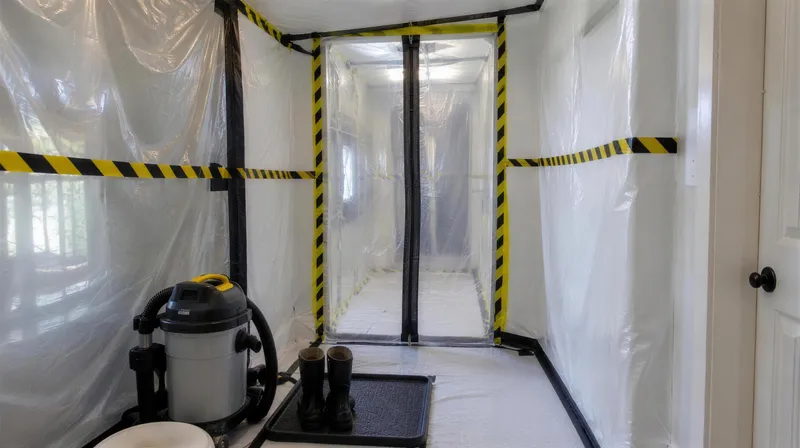
Furniture is moved out of the room, and the home's ventilation is shut down, as Québec.ca recommends. On a high-risk job, the area is closed off with polyethylene sheeting sealed to the floor, walls and ceiling. Workers enter through an airlock, a series of small plastic-sheet chambers where they put on and remove their gear. A decontamination unit with a shower separates the "dirty" and "clean" change rooms.
5. Negative pressure
An air extractor fitted with a HEPA filter draws air out of the work area and exhausts it once filtered. HEPA (high-efficiency particulate air) filters trap very fine particles, including asbestos fibres. The area stays at slightly lower pressure than the rest of the house, so if there is a leak, air flows in rather than out. For high-risk jobs, the ASP Construction guide specifies negative pressure of 1 to 4 Pa and at least 4 air changes per hour.
6. Removal
Workers wet the material to limit dust, then remove it with suitable tools. For an insulated pipe, they may use a glove bag: a clear bag sealed around the pipe, with built-in gloves, so the insulation comes off without opening the room to the air. Workers wear respirators.
7. HEPA cleanup
Every surface in the area is HEPA-vacuumed and wet-wiped. Debris is wetted or vacuumed, never dry-swept (s. 3.23.10). On a high-risk job, the enclosure is checked for leaks at the start and end of each shift.
8. Air testing
An air test measures how many fibres are in the air. A pump draws air through a filter, and a lab then analyzes the filter. On a high-risk job, air is sampled every shift and results must be available within 24 hours. Before the containment comes down, ask whether a final air test is planned and who does it. More on the asbestos air test.
9. Waste disposal
Waste goes into airtight containers with a permanent label showing they contain asbestos (s. 3.23.12.1 and 3.23.13). The contractor then takes it to an authorized landfill. It does not go to an écocentre (municipal drop-off centre) or in your garbage bin. For the full rules, see our asbestos regulation guide (in French).
Low, moderate or high risk: what the rules require
Asbestos work on a construction site falls under the CSTC, which CNESST (Québec's workplace health and safety board) enforces. Section 3.23.2 sorts the work into three risk levels.
| Risk level | Examples of work (CSTC, s. 3.23.2) |
|---|---|
| Low | Handling or removing non-friable products that stay intact: vinyl tiles, gaskets, asbestos-cement. Cutting or drilling with tools fitted with a HEPA vacuum. |
| Moderate | Removing a false ceiling to reach friable material. Glove-bag removal. Small volumes of friable material (up to 0.03 m³) in a minor renovation. Removing drywall installed with asbestos joint compound. |
| High | Removing friable asbestos. Cleaning ventilation systems in buildings with sprayed asbestos. Using power tools without HEPA extraction on asbestos products. Repairing refractory furnaces or boilers. |
Requirements rise with the level. For a high-risk job, section 3.23.16 requires, according to the ASP Construction guide:
- a sealed enclosure under negative pressure, with HEPA extraction of at least 4 air changes per hour;
- a decontamination unit with a shower between the dirty and clean change rooms;
- respirators;
- air sampling every shift, with results within 24 hours;
- an integrity check of the enclosure at the start and end of each shift.
For workers, Québec lowered the permissible exposure value (VEA) for asbestos to 0.1 fibre per cubic centimetre of air in 2022. It is the limit on airborne fibres set to protect workers.
Can you remove asbestos yourself?
Québec.ca is clear: never do the work yourself if an inspection finds asbestos. For vermiculite, the message is the same: never try to remove the insulation yourself. Removal by the homeowner is strongly discouraged, for concrete reasons:
- Without containment and negative pressure, fibres travel to other rooms, into ventilation ducts and onto your clothes.
- You have no simple way to dispose of the waste. In Châteauguay, Granby and Saint-Jean-sur-Richelieu, the écocentre explicitly refuses asbestos.
Choosing an asbestos removal contractor
Québec has no official accreditation or certification program for asbestos work. If a contractor claims an "asbestos certification", ask which organization issued it and what it covers. Québec.ca recommends checking these points instead:
- A valid RBQ licence. The Régie du bâtiment du Québec (RBQ) is Québec's building authority. A specialized contractor should hold subclass 2.7 or 7; a general contractor, subclass 1.2 or 1.3. Check the number with the RBQ.
- Asbestos training for the workers. Section 3.23.7 of the CSTC requires the employer to provide a written training program. Ask to see it.
- Liability insurance in force, with written proof.
- A written work plan: risk level, containment method, air testing and where the waste goes.
Through our service, your quote comes from a partner contractor in your area that holds its own RBQ licence. Local details are on our pages for Longueuil, Brossard and Châteauguay.
How long it takes and what it costs
Duration depends on the area, the type of material and the risk level. A high-risk job needs more preparation than removing intact tiles. Add the lab turnaround for testing beforehand, and always ask for a written schedule.
On budget, RenoQuotes puts a full asbestos removal job in a typical house at $4,000 to $11,000 (indicative, October 2026). Even a job of only a few square feet often costs $2,500 to $3,000, because setup costs (containment, equipment, cleanup) weigh heavily on a small area. The full table by type of work is on our asbestos removal cost page.
To learn the real cost of your project, request a quote: you will get an estimate based on your materials and areas.
South Shore / Montérégie
Residential asbestos removal in your city
Each local page covers the housing stock, where asbestos debris goes and the permits to plan for.
Frequently asked questions
Do I have to remove asbestos from my house?
No. Québec.ca says asbestos materials in good condition do not release fibres and are generally safe. Removal becomes worthwhile before renovations that will disturb the material, or if it is damaged and crumbling.
Can I do asbestos removal myself?
It is strongly discouraged. Québec.ca tells homeowners never to do the work themselves. Without containment and HEPA extraction, fibres spread through the house, and you would have no simple way to dispose of the waste.
Do I need to leave the house during asbestos removal?
Québec.ca says to stay out of the work area set up by the contractor and to shut down your ventilation system during the work. Depending on the size of the job, the contractor may advise you to stay elsewhere. Ask about it when you get the quote.
Is an air test done after the work?
On a high-risk job, the air must be sampled every shift, with results within 24 hours. For the end of the job, ask in writing whether a final air test is planned before the containment comes down, and who does it. Its price is set on quote.
Where does the asbestos waste go?
The contractor seals it in airtight containers with a permanent asbestos label and takes it to an authorized landfill. Never take asbestos debris to an écocentre: several on the Rive-Sud explicitly refuse it.
How long does asbestos removal take?
It depends on the area, the material and the risk level. Add the lab turnaround for testing beforehand, usually 2 to 5 business days. Ask for a written schedule in the quote.
Sources
- Québec.ca — Preventing health problems associated with asbestos
- Health Canada — Health risks of asbestos
- INSPQ — Asbestos exposure on construction sites (in French)
- ASP Construction — Prevention during work that may release asbestos dust, 2023, rev. 2024 (in French)
- Québec.ca — New permissible exposure values for airborne asbestos, 2022 (in French)
- RenoQuotes — Asbestos testing cost: what to expect before renovating (April 2026)
- RenoQuotes — How much does asbestos abatement cost per square foot (July 2026)
- RenoQuotes — Asbestos abatement costs in Québec in 2026 (June 2026)
- Ville de Châteauguay — Écocentre (in French)
- MRC de la Haute-Yamaska — Drop-off at écocentres (in French)
- Compo Haut-Richelieu — Écocentres: what to bring (in French)
Updated
Free quote
Talk to a qualified contractor in your area.
Describe your situation in two minutes. Your request goes to a partner contractor in your area only and is never resold.