Vermiculite · Updated October 17, 2026
Vermiculite Insulation in the Attic: Does It Contain Asbestos?
Vermiculite insulation sold between 1920 and 1990 may contain asbestos, because much of it came from the Libby mine in Montana and was sold under the Zonolite brand. If it is intact and nobody disturbs it, leave it in place; if you plan attic work, have it tested and removed by a contractor trained in asbestos.
On this page
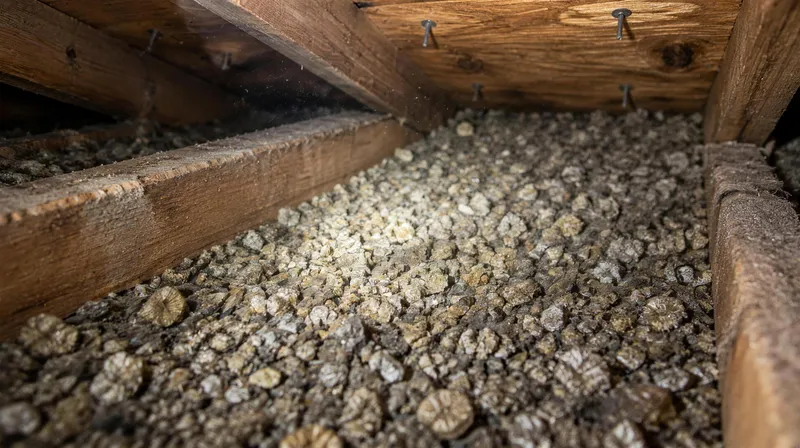
You lifted the attic hatch and found loose, lightweight pebbles that are grey-brown or golden. That is probably vermiculite insulation, and some of it may contain asbestos. Start with the reassuring part: Health Canada says asbestos poses no significant health risk when it is left undisturbed. But if you plan to renovate, insulate or work in the attic, the vermiculite should be tested and then removed by a trained contractor. Here is how to recognize it, what the authorities advise and what removal costs.
What vermiculite insulation looks like
Vermiculite is a mineral heated until it puffs up, a bit like popcorn. The result is a very light granule that was once poured into attics as loose-fill insulation. Look for these signs:
- Granules a few millimetres across, shaped like tiny accordions or flakes.
- Colour grey-brown, beige or gold, sometimes with a silvery shine.
- Loose fill poured between the attic joists, not batts or rolls.
- Light texture that shifts easily and can slide into wall cavities or around light fixtures.
Don't confuse it with cellulose (fluffy grey paper fibres) or mineral wool (fibres in batts or flakes). If you are unsure, don't touch it: a photo taken from the hatch is enough to discuss it with a professional.
The asbestos link: the Libby mine and Zonolite
In a 2004 advisory, Health Canada explained that much of the vermiculite insulation sold in Canada came from the Libby mine in Montana. It was sold mainly under the Zonolite brand and may contain asbestos.
Québec.ca adds that some vermiculite insulation sold between 1920 and 1990 may contain asbestos fibres. Not all vermiculite is contaminated, but you can't tell by looking. That is why it is treated as asbestos until a lab says otherwise.
The danger comes from fibres. When vermiculite is disturbed, fine asbestos fibres can get into the air and be inhaled. Québec.ca links asbestos exposure to asbestosis, mesothelioma (a rare form of cancer) and lung cancer. These diseases can take several decades to appear. Our guide to asbestos in homes covers the other materials to watch for.
What to do and what not to do
Health Canada's advice on vermiculite insulation comes down to four points:
- leave it undisturbed and don't try to remove it yourself;
- don't store items in the attic;
- repair any cracks or holes in the walls and ceilings;
- hire professionals trained to handle asbestos if you plan to renovate.
In practice, that means:
- Don't go up into the attic to store boxes or move around.
- Don't use a household vacuum on fallen vermiculite: leave that cleanup to a professional.
- Don't cut into the ceiling below the attic (light fixture, fan, speaker) before the insulation is tested.
- Don't blow new insulation over it without professional advice, since the work disturbs it.
Testing vermiculite
A test confirms whether your vermiculite contains asbestos. Since Health Canada advises leaving the insulation undisturbed, the sample should be taken by a trained professional, not by you.
The sample goes to a lab. For vermiculite, EMSL Canada offers TEM analysis (transmission electron microscopy, a very powerful microscope that can see extremely fine fibres). The homeowner rate is $395 to $595 per sample, depending on turnaround (indicative, October 2026).
Some homeowners skip the test and simply treat the vermiculite as asbestos. That is a sound choice when removal is already planned, because the job follows the same rules either way. Our asbestos testing page explains methods and turnaround times.
Removing vermiculite from the attic
Loose vermiculite is friable: it crumbles and moves easily. Québec's Safety Code for the construction industry (art. 3.23.2) classes the removal of friable asbestos as high-risk work. Removing contaminated vermiculite therefore generally follows the strictest requirements.
The steps of a removal job
- Inspection and quote. The contractor measures the area, checks access and looks for spots where vermiculite has slid into walls.
- Containment. The attic is sealed off from the house with polyethylene sheeting. Ceiling openings (hatch, light fixtures) are closed.
- Negative pressure. A unit with a HEPA filter (a very high-efficiency filter that traps the finest particles) pulls air out of the work area. Air always flows from the house toward the attic, never the reverse. The Code requires 1 to 4 Pa of negative pressure and at least 4 air changes per hour.
- Decontamination unit. Workers enter and leave through an airlock with a shower between the "dirty" and "clean" change rooms, and they wear respirators.
- HEPA vacuum removal. The vermiculite is vacuumed out with HEPA-filtered equipment, then the joists and cavities are cleaned.
- Air checks. Air is sampled every shift, with results within 24 hours. The enclosure is checked at the start and end of each shift.
- Disposal. Waste goes into sealed containers with a permanent asbestos label and is trucked to an authorized landfill.
Vermiculite insulation must be handled as asbestos waste by the contractor. Never take it to an écocentre (municipal drop-off centre).
During the work
Québec.ca advises staying out of the work area and shutting down your home's ventilation system during the job. Ask the contractor when you can use the rooms under the attic again.
Choosing a contractor
Québec has no official asbestos certification. Instead, check the contractor's Régie du bâtiment du Québec (RBQ) licence (subclasses 1.2, 1.3, 2.7 or 7) and the asbestos training of its workers. The work is done by a partner contractor in your area with its own RBQ licence. Removal is often part of a full attic insulation removal job, followed by re-insulation.
Vermiculite removal cost
| Attic area | Indicative removal price |
|---|---|
| Per square foot | $8 to $15/sq ft |
| 500 sq ft | about $4,500 to $7,500 |
| 1,000 sq ft | about $8,000 to $14,500 |
| 1,500 sq ft and up | about $12,000 to $22,000 and up |
| Re-insulation (example: blown cellulose R-60 on 1,000 sq ft) | about $3,200 |
Indicative, October 2026. Source: Soumission Rénovation (September 2026).
The price depends on attic access, vermiculite depth, obstacles such as ducts and wiring, and how much has slid into the walls. Compare two or three detailed quotes. Our asbestos removal cost guide explains the other cost factors.
Rénoclimat: what qualifies
No grant covers asbestos removal to our knowledge; the re-insulation that follows may qualify for Rénoclimat, Québec's home energy-retrofit program. It pays $50 to $1,500 for attic insulation when at least 20% of the roof area is insulated. Rénoclimat changed its terms on October 1, 2026 and no longer books pre-work energy evaluations under the old terms: check the current conditions on Québec.ca before planning the re-insulation.
Vermiculite removal itself is not eligible, since it does not improve energy efficiency. If the vermiculite contains asbestos, the blower-door test (the airtightness test) is skipped and the owner signs a waiver. Check the program conditions before work starts.
For a firm price on your attic, request a free quote from a partner contractor in your area.
Selling or buying a house with vermiculite
Vermiculite appears on Québec's seller declaration. The OACIQ (Québec's real estate brokerage regulator) form Declarations by the seller of the immovable asks two questions that target it directly:
- D7.4: have products that may contain asbestos ever been used? Vermiculite has its own checkbox.
- D8.5: what type of insulation is in the attic? Vermiculite is one of the options.
If you are selling, declare what you know. A lab report or a removal invoice reassures buyers and makes negotiation easier.
If you are buying, read those two answers closely and ask your inspector to look in the attic. If vermiculite is there, have it tested before your conditions expire and get a removal quote. You can then negotiate knowing the real cost.
South Shore / Montérégie
Vermiculite insulation removal in your city
Each local page covers the housing stock, where asbestos debris goes and the permits to plan for.
Frequently asked questions
Does all vermiculite insulation contain asbestos?
Not necessarily. Québec.ca says some vermiculite insulation sold between 1920 and 1990 may contain asbestos, and Health Canada notes that much of it came from the Libby mine in Montana. Only a lab test can confirm it. Until then, treat it as if it does.
Is it dangerous to live with vermiculite in the attic?
Health Canada says there is no significant health risk when asbestos materials are left undisturbed or sealed behind walls and floorboards. The risk comes when the vermiculite is disturbed and dust gets into the house. Don't store items in the attic, and repair cracks and holes in walls and ceilings.
Can I remove vermiculite insulation myself?
It is strongly discouraged. Québec.ca says never to try to remove the insulation yourself, and Health Canada advises hiring professionals trained to handle asbestos. Removal calls for a sealed work area, filtered ventilation and controlled waste disposal.
How much does vermiculite removal cost?
Expect $8 to $15 per square foot. For a 1,000 sq ft attic, that is about $8,000 to $14,500, before re-insulation. These figures are indicative, October 2026, from Soumission Rénovation.
Does Rénoclimat pay for vermiculite removal?
No. Removal is not eligible because it does not improve energy efficiency. The new attic insulation, however, can qualify for $50 to $1,500 if at least 20% of the roof area is insulated.
Where does removed vermiculite go?
Never take it to an écocentre. Vermiculite insulation must be handled as asbestos waste by the contractor, who seals it in labelled, airtight containers and takes it to an authorized landfill.
Sources
- Health Canada — Advisory: vermiculite insulation may contain asbestos (archived, 2004)
- Health Canada — Health risks of asbestos
- Québec.ca — Preventing health problems associated with asbestos
- Québec.ca — Effects of asbestos on health
- Québec.ca — Effets de l'amiante sur la santé (latency wording) (in French)
- EMSL Canada — Homeowner sample submission form, March 2025 (in French)
- INSPQ — Asbestos and the Safety Code for the construction industry (in French)
- ASP Construction — Prevention during work that may release asbestos dust, 2023, rev. 2024 (in French)
- Soumission Rénovation — Vermiculite and asbestos attic decontamination prices in Québec, September 2026 (in French)
- Québec.ca — Rénoclimat insulation grant (in French)
- Transition énergétique Québec — Rénoclimat participant guide, November 2024 (in French)
- OACIQ — Declarations by the seller of the immovable (mandatory form, version 06/2022)
Updated
Free quote
Talk to a qualified contractor in your area.
Describe your situation in two minutes. Your request goes to a partner contractor in your area only and is never resold.